(This article was first published in the Critical Path, the monthly newsletter of PMI Sydney Chapter publish in April 2022)
It is not unusual to have four, or probably five different generations in one business unit or team. With retirement age increasing, people working for longer time, and the exponential technological changes in the last few decades, all of this introduced significant differences in the mindsets, behaviours, and assumptions of people from different generations. Ignoring these differences will turn an enriching generational diversity into annoying gaps.
More Generation Z workers (born after 1994) are entering the workplace these days. They are rubbing shoulders with Millennials (born 1980-1994), Generation X (born 1965-1979) and Baby Boomers (born before 1965). At times, you may also find some employees from the Silent Generation (born before 1946) in your team. Indeed, this is adding challenges for managers and team members alike.
Attitude, working style, perception, life experience, and aspirations, are some of the differences across the generations. Diversity, Equity, and Inclusion (DEI) initiatives sometimes overlook Generational Diversity. While some studies in the US indicate that only 8% of companies include Age in their DEI strategies, there is a growing discussion and interest in acknowledging this diversity and executing strategies to leverage the cross-pollination of generational knowledge and skills as an accelerator for success. It is argued that combining the wisdom and business planning of the more experienced (older) staff with the energy, excitement and new skills of the younger generation ensures a more sustainable progress.
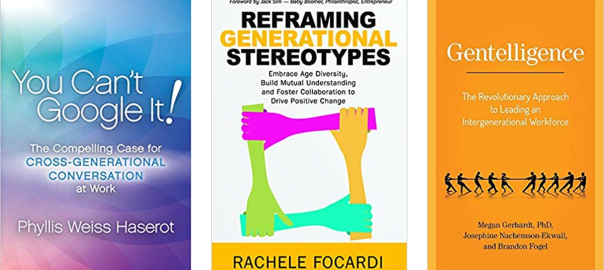
Phyllis Weiss Haserot invented the term GENgagement: “the state of achieving harmony, mutual involvement and cooperation, flow, and ongoing absorption in work with people of different generations.” In her interesting book You Can’t Google it, Phyllis Weiss Haserot asserts that organisations need continuity, heart, talent, inspiration, common purpose, and to transfer wisdom through the ranks in a continual flow. She presents a recipe for GENgagement which includes the ingredient of ‘Enabling multigenerational input to organisational and market strategy and service delivery.’ This can be perpetuated through meaningful and trusting conversations, bonding stories, and working relationships across generations.
Rachele Focardi asserts that “acknowledging and embracing differences is the only way to harness the power of each generation and build multigenerational teams that can truly drive innovation.” In her enriching book Reframing Generational Stereotypes, Rachele Focardi affirms that with the skills of perspective-taking, curiosity, empathy, sensibility, and humility; and using strategies to recognise, understand, embrace and celebrate Generational Diversity, you will be able to shift the minds of senior leaders to inspire, empower, and develop employees across multi-generations.
Gentelligence is the title of a book co-authored by Professor Megan Gerhardt, Josephine Nachemson Ekwall, and Brandon Fogel. The authors present “a revolutionary approach to leading an intergenerational workforce.”
In promoting the term Gentelligence, the authors put forward a framework for moving employees away from generational conflict and toward a productive embrace of one another’s differences. The framework consists of four practices:
- Resist assumptions. Appreciate individual contributions and recognise shared values across generations.
- Adjust the lens. Welcome multiple views, create opportunities for the team to discover each contributor’s strengths, embrace age-diverse perspectives, and develop programs that allow for cross-generational transfers of knowledge.
- Strengthen trust. Share power to demonstrate the value of individual contributions and give every employee permission to question whether a practice aligns with the company’s values.
- Expand the pie. Provide continuous learning opportunities and enable intergenerational knowledge exchange through programs such as mutual mentoring and intergenerational boards.
In conclusion, generational diversity is a blessing. To leverage this wealth of wisdom, enthusiasm, creativity and curiosity, you should avoid erroneous assumptions, facilitate dialogue, recognise differences, encourage intergenerational interaction, embrace conflicting perspectives, and design mentoring, coaching and training programs with generational differences in mind.
 Ibrahim Dani