
(This article was first published in the Critical Path, the monthly newsletter of PMI Sydney Chapter publish in May 2023)
If someone asks you to describe the characteristics of different managers you worked with or know of, it is very likely that you would describe someone as ‘brings out the best in me’ while you describe another as ‘puts me down every time’. Liz Wiseman describes the first type as “Multipliers”: the leaders who use their intelligence to amplify the smarts and capabilities of the people around them, while she describes the second type as “Diminishers”: the leaders who drain intelligence, energy, and capability from the people around them.
Liz Wiseman describes in detail these two types of leaders in her book “Multipliers“. The book is thought-provoking that will make you think differently and challenge your own view on your leadership style and the style of people around you.
The book presents the characteristics and disciplines of Multipliers and contrasts them against Diminishers. The book also claims that Diminishers get less than 50% of the collective productivity of their teams, while Multipliers get twice the collective productivity of their teams.
The disciplines of Multipliers and Diminishers are summarised in the accompanying infographic.
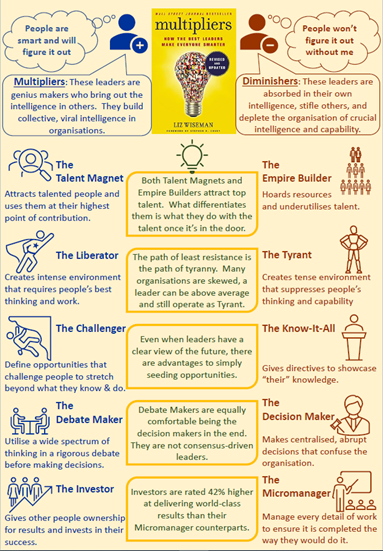
The book also presents the notion of ‘Accidental Diminisher’: “While the narcissistic leaders grab the headlines, the vast majority of diminishing happening inside our workplaces is done by the Accidental Diminisher – managers with the best of intentions, good people who think they are doing a good job leading.” (Page 191).
The book narrates some character virtues and how they can unintentionally lead the manager to becoming an Accidental Diminisher:
- Idea Fountain: while the intention is to stimulate ideas in your team, they overwhelm them and make them shut down.
- Always On: The intention to create infectious energy turns out to consume all the spaces and tune other people out.
- Rescuer: Jumping always to protect your team will make them dependent on you, which weaken their reputation.
- Pacesetter: The intention to set a high standard for quality will render others to become spectators or give up.
- Rapid Responder: Responding quickly to keep the organisation moving fast will create traffic jam of too many decisions and changes.
- Optimist: Continuously promoting a can-do attitude will make people wonder if the leader appreciates the struggle.
- Protector: By keeping people safe from political forces in the organisation deprives them from learning to defend themselves
- Strategist: Creating a compelling reason to move beyond the status quo may make people defer up and second-guess their boss rather than finding answers themselves.
- Perfectionist: The intention to help people produce outstanding work, will make people feel criticised, become disheartened, and stop trying.
The book provides workarounds for the above tendencies, and detailed learning experiments to become a Multiplier. It is packed with insights and controversial arguments that keep your mind buzzing, long after reading every chapter.
 Ibrahim Dani