
(This article was first published in the Critical Path, the monthly newsletter of PMI Sydney Chapter publish in June 2024)
In the evolving landscape of project management, a critical question lingers in the minds of many practitioners: Is Agile, in its myriad forms, truly enhancing our ability to manage projects effectively? While Agile methodologies have dominated discussions and practices over the past decade, recent trends and observations suggest a potential shift in the paradigm.
The Evolution of Project Management Methodologies
Project management has a rich history of evolving methodologies, each developed to address the specific needs of its time. In the 1950s, the Program Evaluation Review Technique (PERT) and the Critical Path Method (CPM) were introduced, providing a structured approach to managing complex projects with a focus on scheduling and resource allocation. The 1980s saw the rise of the Waterfall model, a linear and sequential approach that became the standard in industries like construction and manufacturing.
However, the turn of the millennium brought a significant shift with the introduction of Agile methodologies. The Agile Manifesto, published in 2001, emphasised flexibility, customer collaboration, and responsiveness to change. This new approach revolutionised software development and soon expanded to other industries, promising increased adaptability and faster delivery.
The Rise of Hybrid Models: A Departure from Pure Agile?
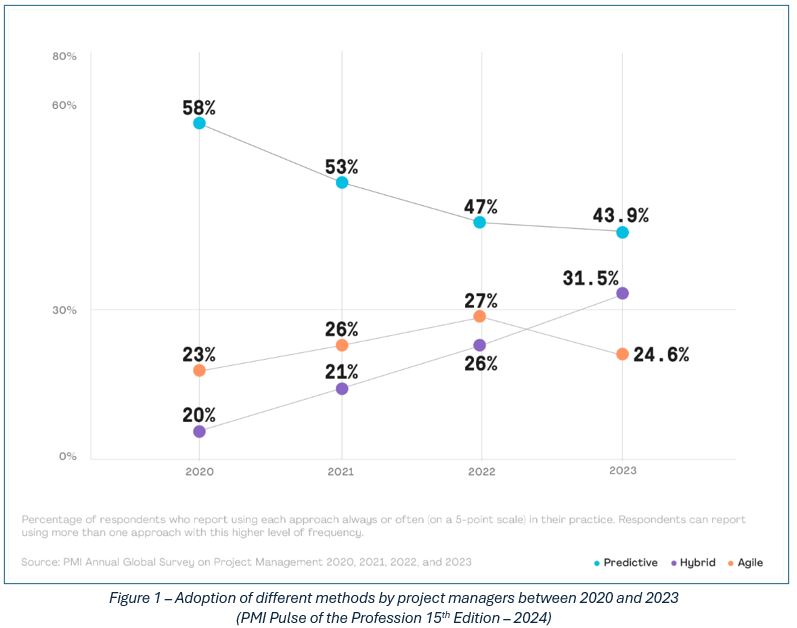
The increasing adoption of hybrid models raises an important question: Are Agile purists beginning to distance themselves from traditional Agile frameworks? The PMI’s latest Pulse of the Profession report (15th Edition, 2024) indicates a decline in Agile adoption for the first time in so many years, alongside a decrease in the decline of traditional project management methods. This trend points towards a growing preference for hybrid approaches, which blend elements of both Agile and traditional methodologies.
As clearly indicated in Figure 1 below, the adoption of Agile is declining after peaking at only 27% among project managers, while Predictive (waterfall/traditional) decline is easing, but still close to double of Agile adoption (43.9% vs 24.6%). While the adoption of Hybrid is steadily increasing, it is doing so at the account of Agile rather than Predictive.
Hybrid models are not a novel concept. They have been employed for years, driven by the principle of fit-for-purpose. This approach tailors project management practices to the unique needs and contexts of individual projects, rather than adhering rigidly to a single methodology. The essence of hybrid models lies in their flexibility and adaptability, allowing project managers to draw from a diverse toolkit to achieve the best outcomes.
The Reality of Hybrid Project Management
But is hybrid truly hybrid? Or is it simply a rebranding of what seasoned project managers have been doing all along? The term ‘hybrid’ suggests a new, innovative approach, yet in practice, it often reflects the pragmatic application of established principles. The shift towards hybrid models highlights a fundamental truth: effective project management is not about rigid adherence to one methodology but about selecting the right tools and techniques for the job at hand.
A case in point is the construction industry, where hybrid methodologies have long been in use. Projects often start with Predictive planning for initial phases like design and procurement, and then transition to Agile techniques during the construction phase to manage changes and unexpected issues more effectively.
Agile’s Waning Influence?
The proliferation of new Agile variants raises questions about the methodology’s core effectiveness. Are these new ‘flavours’ of Agile necessary, or do they signify a broader issue – that Agile, as a concept, may have lost some of its initial lustre? As organisations and project managers continually seek to justify Agile’s relevance, there is a growing sense that we might need to rethink our approach to managing projects.
Reframing Project Management
At its heart, project management is a means to an end, not an end in itself. The ultimate goal is to introduce new ideas, products, and services in a well-planned and efficient manner. This objective transcends any specific methodology, be it Agile, Predictive, or hybrid. The focus should be on achieving project goals and delivering value, rather than on the labels we attach to our methods.
As the project management community navigates this evolving landscape, it is crucial to maintain an open mind and embrace a flexible approach. We must prioritise the success of our projects over strict adherence to any particular methodology. By doing so, we can ensure that we remain effective and responsive to the unique challenges and opportunities that each project presents.
Conclusion
The current discourse around Agile and hybrid methodologies invites us to reflect on the essence of project management. It is a reminder that managing projects is fundamentally about enabling innovation and delivering value. Whether through Agile, hybrid, or traditional methods, our focus should always be on finding the best way to achieve our project goals. As we move forward, we should remain committed to the principles of effective project management, irrespective of the labels we use.
By recognising that the goal of project management is to facilitate the successful introduction of new ideas, products, and services, we can better navigate the complexities of our projects. This perspective allows us to move beyond methodological debates and focus on what truly matters: delivering value and achieving project success.
 Ibrahim Dani