
Category Archives: Articles

To AI or not to AI in Project Management, That is No Longer the question

(This article was first published in the Critical Path, the monthly newsletter of PMI Sydney Chapter publish in November 2024)

I recently skimmed through the book The AI Edge by Jeb Blount and Anthony Iannarino, and I liked their description that AI and Humans are “better together”. The authors argue that the key to plugging into AI is to adopt it, adapt it, and become adept at it. Taking this concept to project management, the question is not whether to use AI in project management or not, but how quickly organisations and project managers can effectively adopt AI, adapt it, and become adept at it: how to use AI effectively, tackle inherent challenges, address ethical concerns, and maximise the technology’s benefits.

AI Integration: An Unstoppable Force in Project Management

AI is no longer a hypothetical addition to project management—it’s an inevitable one. The growing adoption of AI tools has provided a competitive edge, enabling data analysis, predictive analytics, and automation of routine tasks, which in turn enhances productivity and drives successful project outcomes. Organisations that are already leveraging AI benefit from its capacity to streamline processes, analyse vast amounts of data, and make project management more efficient. As more businesses recognise AI’s advantages, the adoption curve accelerates, making AI integration essential for staying competitive.

Upskilling: Essential for Project Managers in the AI Era

AI’s integration calls for a shift in the skill sets of project managers. As AI tools continue to evolve, understanding how to leverage them becomes crucial. Project managers need to acquire foundational knowledge of AI technologies, data interpretation, and basic analytics. Upskilling in these areas allows them to harness AI more effectively, improving their ability to work alongside AI and use it to augment their capabilities.

AI as a Collaborative, Not a Replacement, Tool

Contrary to fears that AI will replace human roles, and project manager roles in particular, its potential lies in its ability to enhance and complement human work. AI can augment project management by handling routine tasks, but it does not replace the need for human judgment, empathy, and leadership. AI’s role in project management should be seen as one that enhances the project manager’s role rather than competing with it. With AI handling data-driven aspects, project managers can focus on fostering creativity, problem-solving, and collaborative team environments. In other words, AI will not replace project managers, project managers who use AI effectively will replace those who don’t.

Overcoming Challenges in AI Adoption

Integrating AI into project management presents several challenges. Addressing these issues proactively can ensure a smoother transition and more productive outcomes. This is where PMOs have an important role to play.

  1. Data Quality Issues: AI’s effectiveness depends on the quality of data it uses. Inconsistent or inaccurate data can lead to unreliable insights and flawed decision-making. Implementing robust data governance practices and routinely auditing data sources is critical for maintaining high-quality data.
  2. Resistance to Change: Team members may feel uncertain or anxious about adopting AI. Clear communication, training, and change management programs can mitigate these concerns and demonstrate AI’s benefits as an enabler rather than a threat.
  3. Need for Skilled Personnel: Utilising AI effectively requires skilled personnel with expertise in data analysis, AI technology, and critical thinking. Investing in training and upskilling, or hiring talent with these competencies, ensures that AI tools are used to their full potential.
  4. Cost and Resource Allocation: AI adoption can be resource-intensive, necessitating investment in software, infrastructure, and training. Organisations should conduct cost-benefit analyses and seek strategic resource allocation to ensure a return on their AI investments.
  5. Dynamic Project Environments: AI’s data-driven decisions may not fully account for the fluid and human-centric nature of projects. AI should therefore be used to support, not replace, human judgment, especially in adapting to changing conditions and unexpected challenges.

Ethical Considerations: Building Trust in AI Systems

As AI becomes more integral to project management, it’s essential to address ethical concerns. Ensuring data privacy, avoiding bias in AI algorithms, and promoting transparency in AI-driven decisions are crucial steps. Additionally, organisations should establish clear ethical guidelines and conduct regular audits of AI systems to identify and mitigate potential biases or privacy risks. By prioritising ethical AI practices, organisations can build trust among team members, stakeholders, and clients.

By addressing integration challenges and ethical considerations, organisations and project managers can make the most of AI-enabled project management, ultimately driving better project outcomes, fostering innovation, and maintaining a competitive edge.

Conclusion: Embrace the AI Evolution

The shift toward AI in project management is not a matter of “if” but “how fast.” Aspiring project managers should focus on upskilling in AI competencies and staying informed about emerging AI technologies. Familiarity with AI tools and an understanding of data analysis will be invaluable as they enter a landscape where AI plays a central role. Embracing a learning mindset and developing adaptability will allow them to capitalise on AI’s benefits while staying resilient in the face of rapid technological change.

The Agile Dilemma – It Is Time to Rethink PM Approach

(This article was first published in the Critical Path, the monthly newsletter of PMI Sydney Chapter publish in June 2024)

In the evolving landscape of project management, a critical question lingers in the minds of many practitioners: Is Agile, in its myriad forms, truly enhancing our ability to manage projects effectively? While Agile methodologies have dominated discussions and practices over the past decade, recent trends and observations suggest a potential shift in the paradigm.

The Evolution of Project Management Methodologies

Project management has a rich history of evolving methodologies, each developed to address the specific needs of its time. In the 1950s, the Program Evaluation Review Technique (PERT) and the Critical Path Method (CPM) were introduced, providing a structured approach to managing complex projects with a focus on scheduling and resource allocation. The 1980s saw the rise of the Waterfall model, a linear and sequential approach that became the standard in industries like construction and manufacturing.

However, the turn of the millennium brought a significant shift with the introduction of Agile methodologies. The Agile Manifesto, published in 2001, emphasised flexibility, customer collaboration, and responsiveness to change. This new approach revolutionised software development and soon expanded to other industries, promising increased adaptability and faster delivery.

The Rise of Hybrid Models: A Departure from Pure Agile?

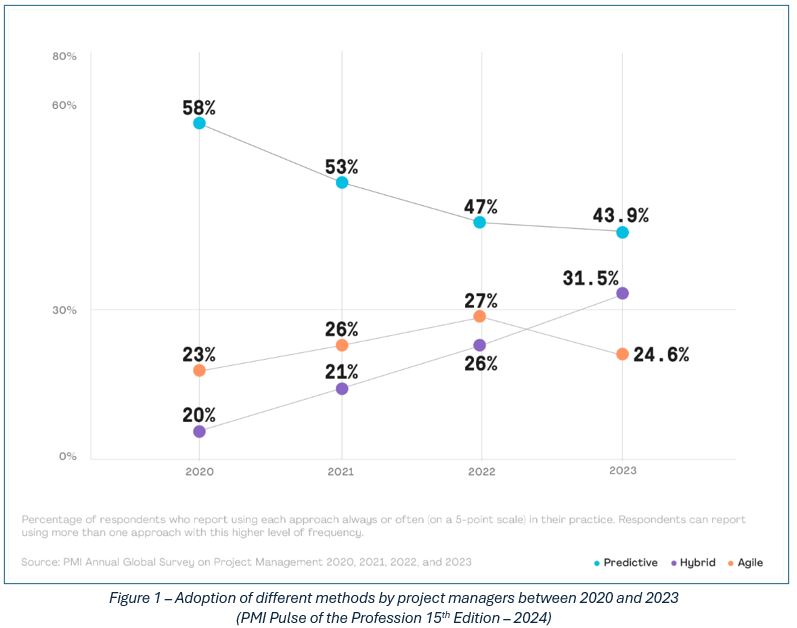
The increasing adoption of hybrid models raises an important question: Are Agile purists beginning to distance themselves from traditional Agile frameworks? The PMI’s latest Pulse of the Profession report (15th Edition, 2024) indicates a decline in Agile adoption for the first time in so many years, alongside a decrease in the decline of traditional project management methods. This trend points towards a growing preference for hybrid approaches, which blend elements of both Agile and traditional methodologies.

As clearly indicated in Figure 1 below, the adoption of Agile is declining after peaking at only 27% among project managers, while Predictive (waterfall/traditional) decline is easing, but still close to double of Agile adoption (43.9% vs 24.6%). While the adoption of Hybrid is steadily increasing, it is doing so at the account of Agile rather than Predictive.

Hybrid models are not a novel concept. They have been employed for years, driven by the principle of fit-for-purpose. This approach tailors project management practices to the unique needs and contexts of individual projects, rather than adhering rigidly to a single methodology. The essence of hybrid models lies in their flexibility and adaptability, allowing project managers to draw from a diverse toolkit to achieve the best outcomes.

The Reality of Hybrid Project Management

But is hybrid truly hybrid? Or is it simply a rebranding of what seasoned project managers have been doing all along? The term ‘hybrid’ suggests a new, innovative approach, yet in practice, it often reflects the pragmatic application of established principles. The shift towards hybrid models highlights a fundamental truth: effective project management is not about rigid adherence to one methodology but about selecting the right tools and techniques for the job at hand.

A case in point is the construction industry, where hybrid methodologies have long been in use. Projects often start with Predictive planning for initial phases like design and procurement, and then transition to Agile techniques during the construction phase to manage changes and unexpected issues more effectively.

Agile’s Waning Influence?

The proliferation of new Agile variants raises questions about the methodology’s core effectiveness. Are these new ‘flavours’ of Agile necessary, or do they signify a broader issue – that Agile, as a concept, may have lost some of its initial lustre? As organisations and project managers continually seek to justify Agile’s relevance, there is a growing sense that we might need to rethink our approach to managing projects.

Reframing Project Management

At its heart, project management is a means to an end, not an end in itself. The ultimate goal is to introduce new ideas, products, and services in a well-planned and efficient manner. This objective transcends any specific methodology, be it Agile, Predictive, or hybrid. The focus should be on achieving project goals and delivering value, rather than on the labels we attach to our methods.

As the project management community navigates this evolving landscape, it is crucial to maintain an open mind and embrace a flexible approach. We must prioritise the success of our projects over strict adherence to any particular methodology. By doing so, we can ensure that we remain effective and responsive to the unique challenges and opportunities that each project presents.

Conclusion

The current discourse around Agile and hybrid methodologies invites us to reflect on the essence of project management. It is a reminder that managing projects is fundamentally about enabling innovation and delivering value. Whether through Agile, hybrid, or traditional methods, our focus should always be on finding the best way to achieve our project goals. As we move forward, we should remain committed to the principles of effective project management, irrespective of the labels we use.

By recognising that the goal of project management is to facilitate the successful introduction of new ideas, products, and services, we can better navigate the complexities of our projects. This perspective allows us to move beyond methodological debates and focus on what truly matters: delivering value and achieving project success.